 Home

 Roadside Assistance
 Periodic Service (SOW)
 ChallanPay
 Corporate Partnership



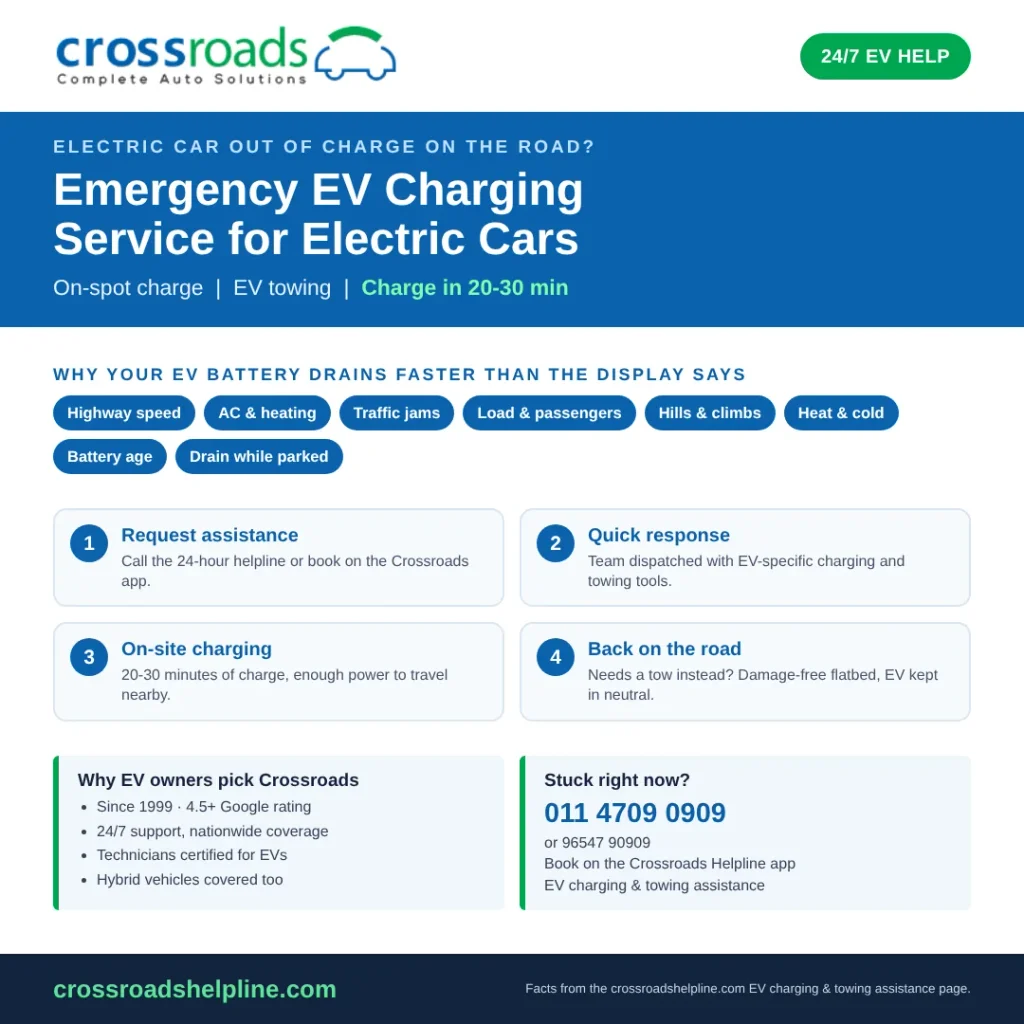
An emergency EV charging service for electric cars brings charge to your vehicle where it has stopped, instead of you somehow reaching a charging station. Crossroads Helpline sends a trained technician with EV charging equipment, 24 hours a day, anywhere in India. The company says an emergency charge takes 20 to 30 minutes and gives enough power to travel nearby.
When Do You Need an Emergency EV Charging Service for Electric Cars?
You are on the highway. The estimated range was 70 km when you left the last town, and the next fast charger is 40 km ahead. Then the number starts falling faster than the kilometres you are covering. 30. 22. 14. The car begins warning you. You switch off the air conditioning, roll the window down, and slow to 50 km/h hoping the number will hold.
Anyone who drives an electric car in India has felt some version of this. It is not carelessness. The range number on the screen is an estimate, and the road decides whether that estimate was honest. When it is not, you are sitting on the shoulder of a highway with a car that will not move and no petrol pump that can help you.
That is the exact situation this blog is about. First, the charging problems EV owners actually run into. Then why the battery empties faster than the display promised. And then what to do about it on the spot.
What Charging Problems Do Electric Car Owners Face in India?
The problems are rarely about the car itself. They are about the gap between where your charge runs out and where charge is available.
The Charger You Planned For Is Not Usable
You route your trip around one charging station, and when you arrive the connector is occupied by another car, the unit is out of order, or the whole site has no power. The planning was correct. The charger was not.
The App or Payment Fails at the Charger
The charger works, but the app will not authenticate, the QR scan does not go through, or the payment keeps failing on a weak network. You are standing next to a working charger that will not start a session.
The Charger Is Far Slower Than Expected
You stop expecting a fast charge and get a slow AC unit instead. A top-up that should have taken 40 minutes now needs several hours, which is not a fix when you still have 100 km to cover that night.
Charge Runs Out Before the Next Station
The most common one. The distance between two usable chargers was longer than the real range of your car on that day, in that traffic, with that load. The gap wins.
No Charging Option Where You Parked
You rely on a public charger near home or office, and it is blocked, shut, or removed. Overnight charging does not happen, and the next morning you start the day with a battery that cannot complete your run.
Connector and Cable Mismatch
Your car uses one standard and the available unit offers another, or your portable cable is sitting at home. The charger is there, but it cannot physically connect to your car.
It Happens at 2 AM
Charging stations with staff on site are not everywhere, and an unattended site with a dead unit at night leaves you with no one to ask. This is where a 24-hour helpline matters more than a map of chargers.
Why Does an EV Battery Drain Faster Than You Expect?
The battery is not faulty. Electric cars simply spend energy on things that a fuel gauge never had to show you. These are the usual reasons the range falls quicker than the number suggested.
Highway speed. Air resistance rises sharply as speed rises. An EV driven at 110 km/h uses noticeably more energy per kilometre than the same car at 70 km/h. A long, fast run is the quickest way to miss a range estimate.
Air conditioning and heating. Cooling the cabin in a Delhi summer or heating it on a winter morning draws power straight from the same battery that moves the car. In an engine car, that load is nearly invisible. In an EV, it is kilometres.
Stop-and-go traffic with the AC on. Standing still in a jam, the car is not covering distance but the cabin, lights and electronics keep consuming. Your remaining kilometres drop while the odometer stays put.
Weight, passengers and luggage. A full car with a loaded boot asks more from the battery, and the effect grows on inclines and flyovers.
Hills and climbs. Climbing uses a lot of energy. You get some of it back on the way down through regenerative braking, but never all of it.
Heat and cold. Lithium batteries behave differently at extremes. Very cold mornings reduce the usable charge temporarily, and sustained heat makes the cooling system work harder. If you have read about how cold weather batteries behave in regular cars, the same principle applies with different symptoms in an EV.
Driving style. Hard acceleration and late braking waste the energy that smooth driving and regenerative braking would have preserved.
Battery age and health. After years and many charge cycles, a pack holds less than it did when new. The car may still show a familiar number, but the real cushion is smaller.
Charging habits. Frequent fast charging, and regularly sitting at a very low state of charge, are not kind to a pack over the long run.
Drain while parked. Electronics, pre-conditioning and background systems use a little charge even when the car is standing. Leave it parked for days at a low percentage and you will come back to less than you left.
Put two or three of these together on one trip, which is normal, and the range estimate from an hour ago stops being true.
What Should You Do if Your Electric Car Stops With No Charge?
Do these in order. It takes two minutes and it keeps you safe.
- Move off the carriageway while the car can still roll. The shoulder, a service lane, a flat spot off the road.
- Switch on hazard lights and place the warning triangle well behind the car.
- In an EV, do not keep the cabin cooling running on the last few percent. You need that charge for moving the car.
- Note your exact location: a landmark, a toll plaza, an exit number, or a pin from your phone.
- On a busy highway, especially after dark, stay inside the car with seatbelts on rather than standing beside traffic.
- Call for help. Do not push an electric car or try to tow it with a rope behind a friend’s vehicle.
- If there is any accident risk or injury, call 112 first.
How Does an Emergency EV Charging Service for Electric Cars Work?
Crossroads Helpline runs this as a four-step process on its EV charging assistance page.
Step 1: Request assistance. Call the 24-hour helpline on 011 4709 0909 or 96547 90909, or book through the Crossroads app, and say that your electric car is out of charge.
Step 2: Quick response. The team is dispatched with the right equipment for an EV rather than a general breakdown van.
Step 3: On-site service. A technician charges your car where it stands. Crossroads says an emergency charge takes 20 to 30 minutes and provides enough power for nearby travel, which is what you need to reach a proper charging station or get home.
Step 4: Back on the road. You drive away and finish your journey, with the next charging stop now within reach.
The company states that its charging and towing tools meet industry safety standards and that its technicians are certified to handle EV-specific requirements. Hybrid vehicles are covered as well. Support runs 24/7 with nationwide coverage.
When Does an EV Need Towing Instead of a Charge?
Sometimes charge is not the problem. If your electric car has a mechanical fault or a flat tyre, or if it cannot safely be driven even after a top-up, the right answer is EV towing rather than an on-spot charge.
This matters for electric cars specifically. An EV should be moved on a flatbed or with specialised equipment, because the wrong towing method can damage sensitive components and the drivetrain. Crossroads uses EV-specific towing tools for a damage-free lift and takes the vehicle to the nearest service station. One useful thing to remember on the spot: keep the EV in neutral while it is being towed.
Both services sit on the same helpline, so one call covers either outcome. The technician decides on site what your car actually needs.
Why Choose Crossroads Helpline for 24 Hour EV Support?
Crossroads has been in roadside assistance since 1999, long before EVs became common on Indian roads, and the numbers on its site reflect that scale: 3,50,000+ active subscriptions, 16,50,000 services delivered, 180+ repairs a day, 95% on-time service and a 4.5+ average Google rating.
For an EV owner, these are the parts that count:
- 24/7 availability with nationwide coverage, not working-hours support
- Technicians certified for EV-specific requirements, with EV charging and towing equipment
- Both emergency charging and damage-free EV towing from a single number
- Help for hybrid vehicles too
- Card, debit card, prepaid wallet and UPI payments accepted
- Roadside Assistance and periodic service plans available, so support is arranged before you need it
- A 10% referral discount on your next RSA plan, and a limited-time 20% off on SOW plans
With a Crossroads plan in place, a dead battery on a highway becomes one phone call rather than a search for someone willing to come out.
Conclusion
Running out of charge is not an EV flaw, it is a planning gap that every electric car owner eventually meets on a long or badly timed drive. Knowing why the battery drains faster than expected helps you avoid it. Knowing that an emergency EV charging service for electric cars exists means that when it does happen, you are not stranded. Save 011 4709 0909 in your phone, or contact Crossroads before your next long drive, and get your plan sorted while you are not standing on a highway shoulder.
Frequently Asked Questions
How long does emergency EV charging take?
Crossroads says 20 to 30 minutes, giving enough power to travel nearby and reach a proper charging station.
Does emergency charging fill my battery fully?
No. It provides enough power for nearby travel, so you can reach a charging station or home.
Is emergency EV charging available at night?
Yes. Crossroads EV charging and towing support runs 24/7, with nationwide coverage across India.
Can my electric car be towed normally?
No. EVs need a flatbed or specialised equipment, kept in neutral, to avoid damaging sensitive components.
Does Crossroads help hybrid cars too?
Yes. The EV assistance page confirms that services extend to hybrid vehicles as well.