 Home
Home
 Roadside Assistance
 Periodic Service (SOW)
 ChallanPay
 Corporate Partnership


.webp&w=48&q=75&dpl=dpl_354dmb6cro7ENa9i1BM7Ecp1BQYW "On-Road Emergency Assistance Service")



A dead or weak battery can leave you stranded in unsafe places: basement parking, roadside shoulders, or highway exits. With battery road side assistance, the real goal is not just “get the engine started once”. It is to restore safe, reliable starting so you are not stranded again in a worse location. This guide explains how to tell whether you likely need a jumpstart, a battery replacement, or towing and electrical diagnosis.
This guide focuses on safety-first actions, not DIY repairs.
What the issue is
A “no-start” usually means the car’s 12V battery cannot deliver enough power to crank the engine or power key systems (ECU, fuel pump, immobiliser, starter relay). This is dangerous because drivers often keep trying the ignition, accept unverified help, or attempt battery handling in traffic-exposed areas.
A jumpstart can be the right short-term solution when the battery is simply low on charge. A replacement is the safer option when the battery is failing internally, repeatedly discharging, or the car has a charging/alternator problem that will strand you again.
Common real-world causes
Most battery callouts are predictable. In real roadside cases, these are the usual reasons:
- Battery age and wear: capacity drops over time, and failure can be sudden.
- Short-trip driving: repeated short trips do not fully recharge the battery.
- Long parking: a week or two of non-use can be enough if the battery is already weak.
- Parasitic drain: a light left on, accessory plugged in, or a module staying awake.
- Charging system issue: alternator/charging fault means the car runs but the battery never recovers.
- Loose or corroded terminals: reduces current flow and mimics a “dead battery”.
- Start-stop and high electrical load: modern cars often need stronger batteries (AGM/EFB). Using the wrong type reduces reliability.
Early warning signs drivers ignore
These are the clues that help you decide “jumpstart vs replacement” before you get stranded:
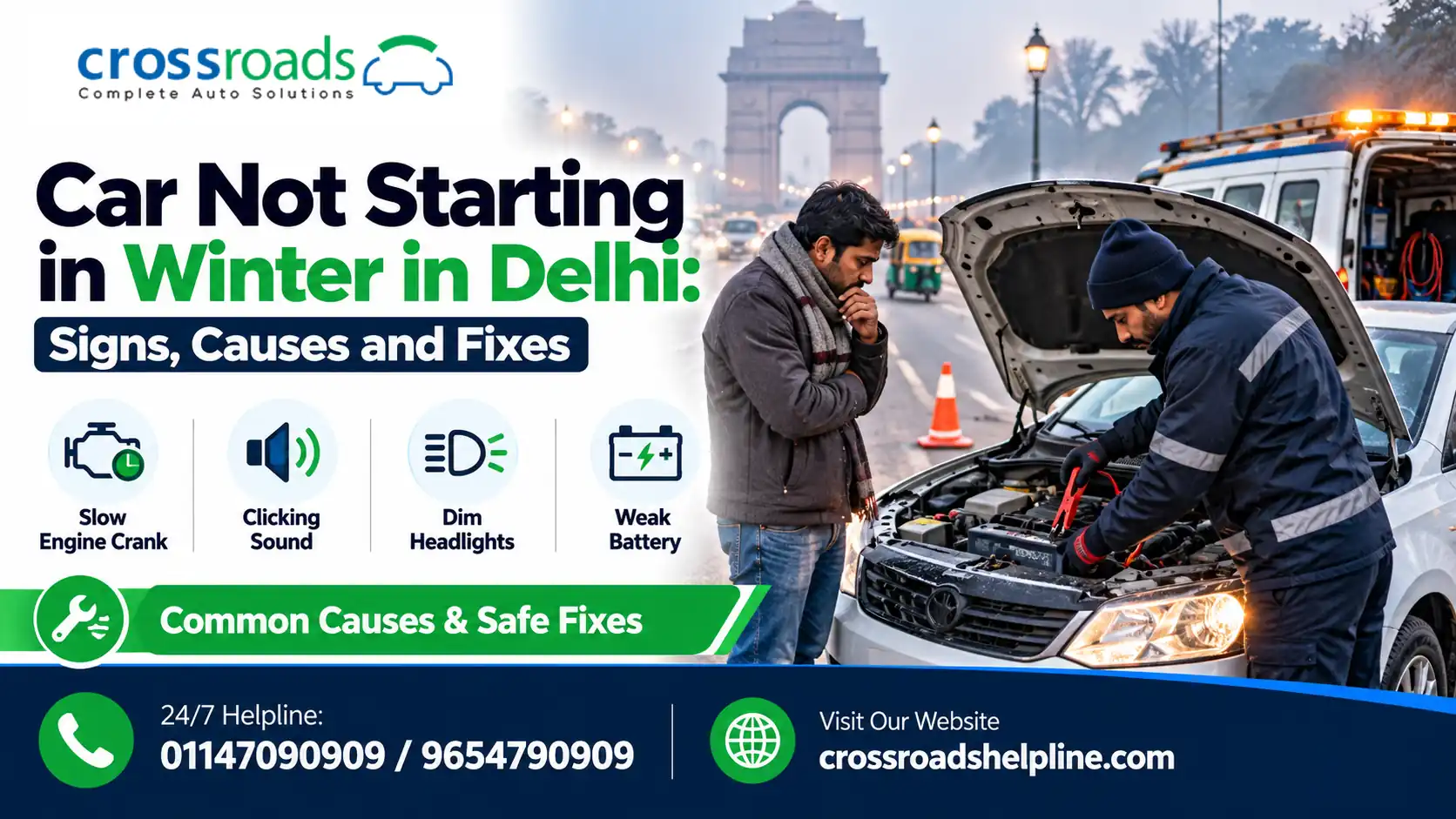
- Slow cranking or the engine turns over sluggishly, especially in the morning.
- Single click or rapid clicking when you try to start.
- Headlights dim sharply during cranking.
- Electronics resetting: clock resets, infotainment reboot, random warning lights that clear later.
- Repeated jumpstart history in recent weeks.
- Battery looks abnormal: swollen casing, visible leakage, heavy corrosion.
- Strong sulphur/rotten-egg smell near the bonnet area (treat as a hazard).
If you see swelling, leakage, smoke, or burning smell, do not treat it as a “normal jumpstart case”.
What to do immediately
Your first job is to reduce roadside risk. Then you can decide the safest assistance.
- Make the scene safe and visible. Use hazard lights, and if you are in a risky spot (narrow shoulder, low light, fast traffic), prioritise moving occupants to the safest available position.
- Secure the car. Put the transmission in Park (or neutral for manuals), apply the parking brake, and switch off accessories to reduce load.
- Do a quick “no-touch” hazard check. If you notice battery swelling, leakage, smoke, or strong burning/sulphur smell, step back and request professional help immediately.
- Call for battery roadside assistance with clear symptoms. Share a live location pin, vehicle details, and exactly what happens when you try to start (no dash lights, lights but no crank, clicking, slow crank). These details help decide whether a jumpstart is appropriate or whether you likely need replacement/diagnosis.
- Avoid repeated start attempts. Repeated cranking can drain a weak battery further and can overheat electrical components.
“This guidance is for safety awareness only. Vehicle conditions vary, and attempting repairs without proper tools or training can be dangerous.”
If you need a verified support route, use car battery jumpstart service: https://www.crossroadshelpline.com/service/car-battery-jumpstart-service-near-me
What NOT to do
These mistakes often cause injury, electronics damage, or another breakdown soon after:
- Do not attempt improvised jumpstarting (random wires, sparking terminals, unsafe tools).
- Do not lean over the battery or smoke near the engine bay during a no-start situation.
- Do not keep “trying again and again”. If it doesn’t start after one or two reasonable attempts, stop and call.
- Do not assume a successful jumpstart means the battery is fine. Many failing batteries start once, then strand you again the same day.
- Do not accept unverified roadside help from unknown operators who appear without a logged request.
When professional roadside assistance is required
Call professionals immediately (and consider towing/diagnosis) when any of these are true:
- You are stuck in a high-risk location (live lane, narrow shoulder, flyover, night, rain/fog).
- The battery shows swelling, leakage, heavy corrosion, smoke, or strong odour.
- You get no dash lights at all (possible terminal/main power issue).
- The car starts with a jump but dies soon after, or warning lights suggest charging failure.
- This is a repeat problem (second/third no-start in a short period).
- You suspect an alternator/charging issue (car was running earlier, then suddenly wouldn’t restart; battery light had been on; electricals were behaving oddly).
In these cases, the safest outcome is often controlled recovery and correct diagnosis, not repeated boosts.
Jumpstart vs replacement: a practical decision guide
Use this simple, safety-first logic. It does not replace diagnosis, but it helps you request the right help.
When a jumpstart is usually enough (for now)
A jumpstart is often reasonable when:
- The car was fine recently, then sat parked and now won’t start.
- You left lights/door ajar and the battery drained once.
- Cranking is slow/clicking, but there are no signs of battery damage (no swelling/leak/smell).
- After the jump, the car runs normally with no charging warning signs.
Even here, a jumpstart is a short-term restore. If the battery is old or the problem repeats, treat it as a replacement/diagnosis case.
When replacement is the safer call
Replacement is more likely needed when:
- The battery is older or has a history of weak starts.
- The car needed a jumpstart recently and is failing again.
- The battery casing looks swollen, terminals are heavily corroded, or performance drops suddenly.
- The car struggles even after being driven previously (suggesting low capacity, not just low charge).
- The vehicle requires a specific battery type (AGM/EFB for start-stop), and the wrong type may already be fitted.
Replacement should be paired with a quick check of basic charging health, otherwise the new battery may also discharge.
When towing/diagnosis is the only reliable option
Ask for towing or deeper electrical diagnosis when:
- The jumpstart does not work at all, or the car loses power again immediately.
- There are electrical burning smells, smoke, or repeated unexplained warning messages.
- The vehicle is in a location where battery work is unsafe.
- Symptoms suggest starter/relay/immobiliser issues rather than a weak battery.
How Crossroads Helpline helps
Crossroads Helpline handles battery callouts as safety-first incidents: location confirmation, hazard checks, and dispatching the right support for a reliable outcome. If a jumpstart is appropriate, the focus is on safe handling and getting you started without risky improvisation. If signs point to a failing battery or charging issue, the team guides the next safe step so you are not stranded again shortly after.
Why trust Crossroads Helpline?
Support is coordinated by a trained roadside team with safety-first dispatch. Help is available 24×7, with practical guidance to reduce roadside exposure and reach a safe resolution.
To compare broader coverage options (including towing support that matters when batteries keep failing), see RSA plan options: https://www.crossroadshelpline.com/plans/rsa-plans
FAQs
1) If my car starts after a jumpstart, do I still need a new battery?
Not always. But if the problem repeats soon, starts are slow, or the battery is older, replacement becomes the safer choice.
2) How do I tell if it’s the battery or the alternator?
A weak battery often shows slow cranking and improves after charging/jumpstart. If the car starts but later dies again, or charging warnings appear, charging diagnosis is important.
3) Is it safe to jumpstart modern cars with lots of electronics?
It can be, but mistakes can damage electronics. Professional roadside help is safer, especially for start-stop systems and AGM/EFB batteries.
4) My dashboard lights come on but the engine won’t crank. Is that still the battery?
Often yes, but it can also be starter/relay/immobiliser issues. Share the exact symptom (clicking vs silence vs slow crank) when you call.
5) What if there are no dashboard lights at all?
That can indicate a deep discharge or a main power/terminal connection issue. Avoid repeated attempts and call for assistance.
6) Should I keep trying every few minutes until it starts?
No. Repeated attempts can drain the battery further and overheat components. It is safer to stop and request help.
7) What’s the safest way to request help quickly?
Use official support channels so your job is logged and dispatched correctly: https://www.crossroadshelpline.com/contact-us
Closing
With battery road side assistance, the safest question is not “can it start once?” but “will it start reliably and safely from here?” Jumpstart is suitable for a one-off low-charge situation. Replacement is safer when the battery is failing or the problem repeats. If symptoms suggest charging, starter, or electrical faults—or the location is unsafe—professional recovery and diagnosis is the right call.