 Home
Home
 Roadside Assistance
 Periodic Service (SOW)
 ChallanPay
 Corporate Partnership


.webp&w=48&q=75&dpl=dpl_354dmb6cro7ENa9i1BM7Ecp1BQYW "On-Road Emergency Assistance Service")



A no-start situation is stressful because it can leave you stranded in an unsafe spot and tempt you into hurried actions around the battery. If you’re searching road side assistance jump start, the safest goal is to protect people first, then get the car started (or recovered) without risking battery injury, vehicle electronics damage, or a roadside collision. You will learn what a jump start is, why cars suddenly won’t start, the warning signs drivers ignore, and exactly when to call professionals.
This guide focuses on safety-first actions, not DIY repairs.
What the issue is
A “jump start” is a method used to start a vehicle when its 12V battery is too weak to crank the engine. It can be dangerous because batteries can release flammable gas, damaged batteries can leak acid, and incorrect connections can damage sensitive electronics. In real roadside cases, the bigger risk is often the location: trying to do anything under pressure on a narrow shoulder or in low visibility.
A safe approach treats “won’t start” as a safety and reliability problem, not a quick roadside task.
Common real-world causes
Most no-start calls come from predictable battery and electrical patterns. Our technicians commonly see:
- Weak or ageing battery: the battery has lost capacity over time, often after repeated short trips or long parking.
- Parasitic drain: a light left on, accessory plugged in, or an electrical module staying awake and draining the battery overnight.
- Loose/dirty battery terminals: poor contact reduces available cranking power.
- Charging system issues: alternator problems can leave the battery undercharged even after driving.
- Extreme heat: heat accelerates battery wear; many batteries fail suddenly after a hot spell.
- Starter motor or relay issues: symptoms can mimic a weak battery but need professional diagnosis.
- Immobiliser/key recognition problems (in some cars): the starter may be blocked even if the battery is fine.
A jump start may get you moving once, but it does not automatically mean the battery is “healthy” again.
Early warning signs drivers ignore
A no-start rarely comes out of nowhere. If you notice these, plan for help before you get stranded:
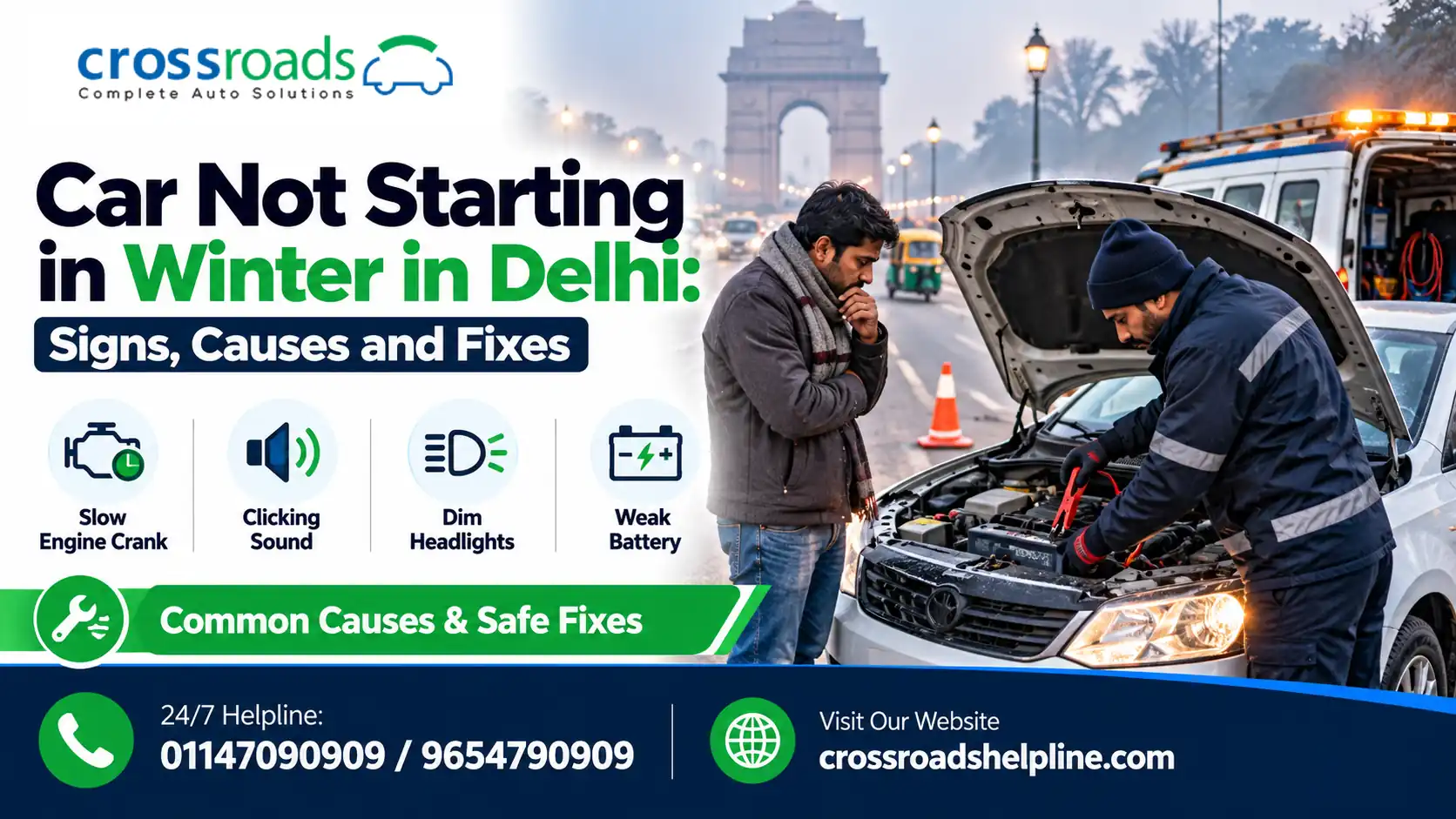
- Slow cranking (engine turns over sluggishly) or a “lazy” start in the morning.
- Clicking sound with no crank, especially after repeated attempts.
- Headlights dim noticeably when you try to start.
- Electrical glitches: clock resets, infotainment reboots, random warning lights that clear after starting.
- Repeated need for jump starts or a battery that dies after a short parking period.
- Battery case looks swollen or there is a strong sulphur/“rotten egg” smell (treat as a hazard).
If the battery looks damaged, smells unusual, or there’s any smoke, treat it as an urgent safety issue and avoid handling it.
What to do immediately
The safest first steps reduce roadside risk and prevent battery-related injury. Do these in order.
- Make the situation safe and visible. If you’re on a road edge, turn on hazard lights and ensure the vehicle is not in a live lane. If you’re in a risky spot (fast traffic, narrow shoulder, poor light), prioritise moving people to the safest available position.
- Secure the vehicle. Put the car in Park (or neutral for manuals), apply the parking brake, and switch off ignition and all accessories (AC, lights, infotainment) to reduce electrical load.
- Do a quick hazard check of the battery area without touching. If you see fluid leakage, swelling, cracks, heavy corrosion, or smell burning/sulphur, do not attempt a jump start. Keep people away from the engine bay and call for professional support.
- Call for professional jump start assistance and share clear symptoms. Tell the dispatcher your location pin and what happens when you turn the key/button (no lights, lights but no crank, clicking, slow crank). This helps decide whether a jump start is appropriate or whether the issue may be starter/charging/immobiliser related.
- Wait safely and avoid repeated start attempts. Repeated cranking can overheat wiring and drain a weak battery further, making the situation harder to resolve.
“This guidance is for safety awareness only. Vehicle conditions vary, and attempting repairs without proper tools or training can be dangerous.”
If you need a verified option for assistance, use car battery jump start service: https://www.crossroadshelpline.com/service/car-battery-jumpstart-service-near-me
What NOT to do
These mistakes are common and can cause injury or expensive vehicle damage:
- Do not attempt a roadside jump start in an unsafe location (highway shoulder, blind curve, poor visibility). The risk from passing traffic often outweighs the benefit of “getting going quickly.”
- Do not lean over the battery or smoke near it. Batteries can vent flammable gas, especially if stressed or damaged.
- Do not use makeshift methods (touching tools to terminals, “sparking” tricks, pushing random wires). This can cause burns, battery damage, or electrical damage.
- Do not keep trying the ignition repeatedly if the car won’t crank. This can worsen the drain and can overheat components.
- Do not assume a successful jump start means the car is safe for longer driving. If the alternator/charging system is weak, the car may stall again soon—sometimes in a more dangerous location.
- Do not accept unverified help from unknown roadside operators who appear without you requesting them through a verified channel.
When professional roadside assistance is required
Request professional roadside assistance (and sometimes towing) when any of these apply:
- You are stranded in a high-risk location: live lane, narrow shoulder, flyover, blind curve, night, heavy rain/fog.
- The battery shows swelling, leakage, heavy corrosion, smoke, or unusual odour.
- You get no dash lights at all (could indicate a connection issue beyond a simple weak battery).
- You hear repeated rapid clicking or there is no crank despite strong lights (may be starter/relay/immobiliser).
- The car starts after a jump but stalls quickly or warning lights suggest charging failure.
- This is the second or third no-start in a short time (needs diagnosis, not repeated boosts).
If recovery is needed, use a verified towing route rather than driving an unreliable vehicle. For location-based routing, you can start from roadside assistance near you: https://www.crossroadshelpline.com/roadside-assistance-near-me
How Crossroads Helpline helps
Crossroads Helpline treats no-start calls as a safety-first roadside event. After you contact the team, dispatch focuses on confirming your exact location, assessing risk (traffic exposure, visibility, occupants), and sending suitable support. On scene, technicians prioritise safe handling around the battery area, controlled starting attempts, and clear next steps if the issue points to charging/starter faults or a battery that is no longer reliable.
Why trust Crossroads Helpline?
Crossroads Helpline dispatches a trained roadside team with safety-first guidance. Support is available 24×7, with a focus on reducing roadside exposure and choosing safe recovery decisions.
For official help requests and follow-up, use Crossroads Helpline contact options: https://www.crossroadshelpline.com/contact-us
FAQs
1) Is a jump start safe for all cars?
Not always. Some vehicles have sensitive electronics and specific procedures. If you are unsure or the battery appears damaged, professional assistance is safer.
2) My car clicks but won’t crank. Is that always the battery?
Often it is a weak battery, but it can also be terminals, starter relay, starter motor, or an immobiliser issue. Sharing the exact symptoms helps the technician decide.
3) The car started after a jump. Can I drive normally now?
Be cautious. If the charging system is weak, the car may stall again. If warning lights appear or the car feels unstable electrically, get it checked promptly.
4) What if there are no dashboard lights at all?
That can indicate a severe battery drain, terminal connection problem, or main electrical issue. Avoid repeated attempts and call for professional help.
5) Should I keep trying to start the car every few minutes?
No. Repeated cranking can worsen the battery state and overheat components. It is safer to wait for assistance after one or two attempts.
6) What if the battery smells odd or looks swollen?
Treat it as a hazard. Do not handle it or attempt a jump start. Keep people away from the engine bay and call for professional support.
7) Can roadside assistance replace the battery on the spot?
Depending on availability and the situation, technicians may advise the safest next step. If the location is unsafe, recovery to a safer place may be recommended first.
Closing
For road side assistance jump start situations, safety comes before speed. Make the scene visible, secure the vehicle, avoid handling a battery that looks or smells abnormal, and call professionals with precise symptoms and location. If the stop location is risky, or if there are signs of charging/starter problems, treat it as a controlled recovery decision—not a roadside experiment.