 Home

 Roadside Assistance
 Periodic Service (SOW)
 ChallanPay
 Corporate Partnership



India’s expanding highway network is transforming the way people and goods move across the country. New expressways, upgraded National Highways and improved connectivity are making journeys more accessible and supporting the growth of logistics, tourism, manufacturing and commercial transportation.
But better roads are only one part of the mobility ecosystem.
As more passenger and commercial vehicles travel across longer distances, the need for dependable roadside assistance, emergency response and vehicle recovery becomes increasingly important. A breakdown on an unfamiliar highway can disrupt a family journey, delay a commercial delivery, or affect the daily operations of a multi-city fleet.
This raises an important question: As India’s highways expand, are the support systems available to motorists and businesses keeping pace?
1. India’s Highway Network Is Expanding Rapidly
India has made significant progress in developing its road infrastructure over the past decade, strengthening connectivity between cities, industrial centres, ports and regional markets.
According to the Ministry of Road Transport and Highways (MoRTH), India’s National Highway network increased from 91,287 km in March 2014 to 1,46,572 km by February 2026, representing growth of approximately 61%.
The expansion is also reflected in the development of higher-capacity road infrastructure:
The operational length of access-controlled National High-Speed Corridors and Expressways increased from 93 km in 2014 to 3,052 km by February 2026.
The four-lane-and-above National Highway network increased from 18,371 km in 2014 to 48,568 km by February 2026.
These developments are improving connectivity and supporting the movement of passengers and goods across different parts of the country.
However, as highway infrastructure grows, so does the importance of ensuring that motorists have access to assistance when unexpected situations arise during their journeys.
2. What Happens When a Vehicle Breaks Down on a Highway?
A vehicle breakdown can happen anywhere, whether on a busy expressway, a remote highway stretch or a road connecting two industrial centres.
For an individual motorist, it may mean an interrupted journey and uncertainty about where to find help. For a commercial vehicle operator, the same situation can lead to delivery delays, vehicle downtime, and additional operational costs.
The nature of the problem also determines the kind of assistance required.
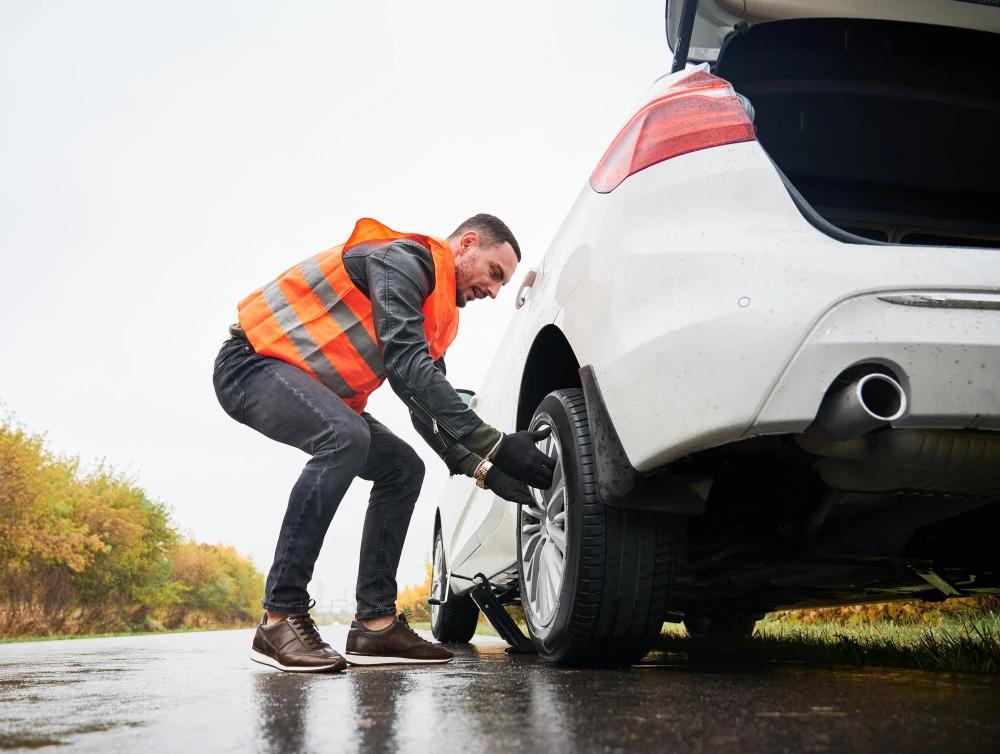
A battery-related issue may be resolved through jumpstart support, while a tyre problem may require a spare-wheel replacement or puncture assistance. More complex mechanical issues may need on-site repair, whereas a vehicle that cannot be restored at the location may require towing or recovery.
The challenge is not simply finding a service provider. It is accessing the right assistance, at the right location, within a reasonable response time.
This makes organized roadside assistance an important part of the wider highway support ecosystem.
3. India’s Highway Emergency Response System
Recognizing the importance of incident response, MoRTH has provisions for Incident Management Services (IMS) on National Highways.
Under the Ministry’s guidelines dated 9 February 2021, these services include:
Rescue ambulances.
Route patrol vehicles.
Tow-away cranes.
Incident monitoring and reporting.
Coordination with relevant emergency services.
The guidelines also provide for Incident Management Centres to remain staffed around the clock on project highways.
These arrangements are intended to support highway users during emergencies and help manage incidents that may affect road safety and traffic movement.
It is important to understand that highway incident management and roadside assistance serve related but distinct purposes. While incident management focuses on emergency response and highway operations, roadside assistance also addresses vehicle-specific problems that motorists and commercial vehicle operators may encounter.
Both contribute to a more dependable travel experience.
4. Understanding the Role of the 1033 National Highway Helpline
The National Highways Authority of India (NHAI) operates the 1033 National Highway Helpline, introduced in 2018 to provide assistance to highway users.
According to a Press Information Bureau (PIB) announcement dated 14 September 2026, the helpline provides round-the-clock support for medical emergencies, vehicle breakdowns, ambulance and crane requirements, and other highway-related concerns.
The announcement also reported that the helpline:
Covers more than 1.46 lakh km of National Highways.
Receives approximately 15,000 calls per day.
Is being upgraded with planned technology enhancements, including AI-assisted call handling, real-time location identification and intelligent dispatch.
The proposed improvements are intended to strengthen the coordination of assistance while retaining human operators for emergency decision-making.
The development of the 1033 helpline highlights how technology and coordinated response systems are becoming increasingly important in highway operations.
However, a helpline is one part of the response process. Effective assistance also depends on the availability of suitable vehicles, trained service personnel and recovery resources at the required locations.
5. Why Roadside Assistance Needs to Be More Accessible
Not every roadside emergency requires the same solution. An effective roadside assistance network must be able to identify the problem and arrange an appropriate response.
Some of the key services that support motorists include:
On-site mechanical assistance
Technicians can attend to eligible mechanical and electrical issues at the breakdown location, helping resolve problems without necessarily moving the vehicle to a workshop.
Battery assistance
Jumpstart support can help motorists deal with certain battery-related issues and resume their journey when the vehicle is otherwise operational.
Tyre assistance
Spare-wheel replacement and puncture support can help address common tyre-related problems, subject to service availability at the location.
Towing and vehicle recovery
When a vehicle cannot be restored at the breakdown location, towing or recovery services help transport it to an appropriate workshop or destination.
The availability of these services across different cities and highway locations can make a meaningful difference to the roadside experience.
For this reason, roadside assistance should not be viewed only as an emergency service. It is also an important component of vehicle ownership, after-sales support and mobility operations.
6. Technology and Coordination: Making Roadside Assistance More Efficient
Managing roadside assistance across a large geographical area involves more than maintaining a network of service providers.
It requires a structured process for receiving requests, understanding the nature of the problem, identifying the nearest suitable resource and monitoring the response.
Technology can strengthen this process through:
Digital service request management: Recording and managing assistance requests systematically.
Real-time location tracking: Helping identify the breakdown location and monitor service movement.
Intelligent service allocation: Assigning suitable service providers based on location and service requirements.
Centralised monitoring: Providing visibility into request status and response progress.
Service performance analysis: Evaluating response times, service quality and operational performance.
These capabilities can help roadside assistance providers improve coordination and manage service requests more effectively.
However, technology alone cannot resolve a roadside emergency. Its effectiveness depends on trained technicians, reliable recovery partners, geographical coverage and the ability to respond to different vehicle requirements.
The combination of technology, people and an accessible service network is what makes roadside assistance dependable.
7. Why Reliable RSA Networks Matter for Businesses
India’s expanding highway network supports a wide range of transportation requirements, from private passenger journeys to commercial logistics and multi-city fleet operations.
For businesses managing vehicles across multiple locations, a breakdown can have consequences beyond the immediate repair requirement. It can affect vehicle utilisation, delivery schedules, customer commitments and operating costs.
A structured Roadside Assistance (RSA) partnership can help businesses manage these requirements through an organised service network rather than independently coordinating every breakdown.
8. Building a More Complete Highway Support Ecosystem
Highway development and emergency support infrastructure need to progress together.
Government agencies, highway operators, automotive manufacturers, insurance providers, fleet businesses and roadside assistance partners each play a different role in supporting road users.
A stronger mobility support ecosystem will depend on continued progress in areas such as:
Wider geographical coverage of emergency and roadside services.
Effective coordination between highway authorities and response agencies.
Accessible vehicle repair, towing and recovery networks.
Technology-enabled service request management.
Consistent service standards across locations.
Greater awareness among motorists about available emergency and roadside assistance services.
The objective is not simply to build more roads. It is to create an environment where people and businesses can travel with greater confidence, knowing that appropriate assistance is accessible when unexpected situations arise.
Conclusion: Better Connectivity Needs Dependable Roadside Support
India’s expanding highway network is an important part of the country’s infrastructure and economic development. Improved connectivity is creating new opportunities for passenger mobility, logistics and commercial transportation.
But the value of this infrastructure also depends on the support systems available to road users beyond the point of construction.
Government-led incident management services, highway helplines, vehicle recovery resources and organised roadside assistance networks all contribute to addressing different challenges that arise during road travel.
At Crossroads Helpline, we believe that dependable mobility requires more than connecting destinations. It requires a coordinated support ecosystem that helps motorists, automotive businesses and fleet operators manage unexpected roadside situations.
With roadside assistance solutions covering two-wheelers, three-wheelers, four-wheelers and light commercial vehicles, Crossroads supports the evolving requirements of India’s mobility ecosystem through on-site assistance, battery support, tyre services and towing solutions.
As India’s highways continue to expand, making dependable roadside assistance more accessible will remain an important part of building a stronger and more reliable mobility network.