 Home
Home
 Roadside Assistance
 Periodic Service (SOW)
 ChallanPay
 Corporate Partnership


.webp&w=48&q=75&dpl=dpl_354dmb6cro7ENa9i1BM7Ecp1BQYW "On-Road Emergency Assistance Service")



A bike breakdown becomes dangerous fast because you are exposed to traffic and have less visibility and protection than a car. If you’re looking for road side assistance for bike riders, the priority is always the same: protect the rider first, then secure the scene, then arrange professional help without attempting risky roadside fixes. This guide explains the safest steps for common situations like breakdowns, tyre issues, and fuel problems, and when it is time to call professionals.
This guide focuses on safety-first actions, not DIY repairs.
What the issue is
Roadside assistance for bike riders means help that comes to your location when your two-wheeler cannot continue safely or cannot be handled safely where it has stopped. The danger is usually not just the mechanical problem. It is the roadside environment: fast vehicles passing close, limited shoulder space, poor lighting, rain, and distracted drivers.
In real roadside cases, serious incidents often happen when riders stand near live traffic, remove the helmet too early, try to fix a puncture on a narrow shoulder, or push a bike in a live lane. A safety-first response reduces exposure and avoids choices that can lead to a secondary collision.
Common real-world causes
Most two-wheeler roadside calls fall into a few patterns:
- Tyre puncture or tyre damage (including sidewall cuts or a sudden loss of pressure) that makes the bike unstable.
- Fuel issues (unexpected empty tank due to long traffic delays, wrong fuel concern, or fuel delivery needed).
- Battery or electrical issues (no-start, intermittent power, blown fuse symptoms, wiring faults).
- Overheating warnings or burning smell (often linked to oil/coolant problems, clutch overheating in traffic, or electrical short smell).
- Chain/sprocket problems (noise, slipping, chain coming off) that make riding unsafe.
- Post-incident problems after a minor fall or impact (handlebar misalignment, brake issues, bent lever, wheel rub).
Even when the problem looks “small,” riding on with reduced tyre pressure, brake issues, or drivetrain problems can cause loss of control.
Early warning signs drivers ignore
Many bike breakdowns give early signals. If you notice these, plan to stop at a safer point and call for help rather than pushing on:
- Tyre warning signs: sudden wobble, heavy steering, the bike “pulling,” rhythmic thumping, or visible damage.
- Brake warning signs: lever feels spongy, reduced braking bite, grinding sound, brake drag, or brake warning light (if equipped).
- Engine/electrical warning signs: repeated stalling, sudden loss of power, flickering lights, burning plastic smell, or warning lights that stay on.
- Drivetrain warning signs: new rattling/metallic noise, chain noise, slipping feel, or jerky acceleration.
- After a bump/pothole hit: new vibration, handlebar not centred, or wheel rubbing.
A simple rule used by many roadside teams: if the issue affects control (tyres/brakes/steering), visibility (lights), or heat/smell/smoke, treat it as a safety issue and stop to seek professional help.
What to do immediately
The safest steps are the ones that reduce your exposure to moving traffic and make you visible.
- Get out of the traffic line safely. If the bike is still controllable, signal early and move to the safest available refuge (a wider shoulder, a service lane, a lay-by, or a side road). Avoid stopping on blind curves, the crest of a flyover, or at the edge of a fast lane.
- Position yourself on the safe side. If you must stop on a road edge, try to keep yourself and any pillion on the side away from moving traffic. Dismount only when you can do so without stepping into a live lane.
- Make yourself and the bike visible. Use hazard lights if your bike has them. If not, keep lights on where possible. At night or in rain/fog, visibility is the main risk—drivers may not see a stationary two-wheeler in time.
- Protect the rider first. Keep your helmet on until you are in a clearly safe position away from traffic. If you have a reflective jacket/vest, use it. Keep children or vulnerable passengers away from the road edge.
- Call professional roadside help early with precise location. Share your live location pin, the road name and direction, nearest landmark, and the symptoms (puncture/tyre damage, fuel issue, no-start, smoke/burning smell, brake issue, chain problem). Mention safety risks (narrow shoulder, low visibility, heavy traffic, night).
- Wait in the safest available spot and stay reachable. If the location is unsafe to stand near the bike, move to a safer position away from traffic without crossing live lanes. Keep your phone available and follow dispatcher guidance.
“This guidance is for safety awareness only. Vehicle conditions vary, and attempting repairs without proper tools or training can be dangerous.”
For two-wheeler specific roadside support information, use: https://www.crossroadshelpline.com/two-wheeler
For location-based access to help, use: https://www.crossroadshelpline.com/roadside-assistance-near-me
What NOT to do
These are common rider mistakes that increase the risk of a crash or injury:
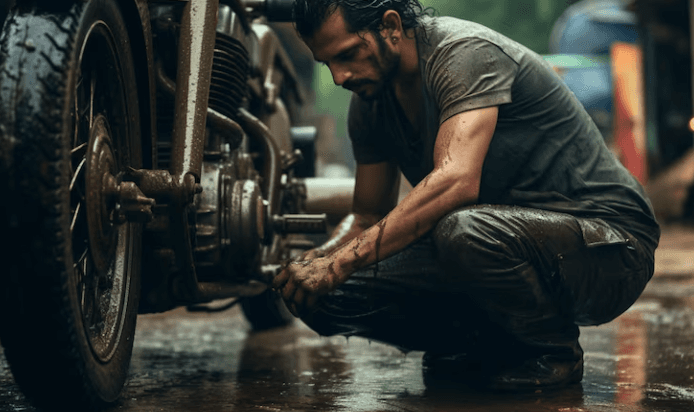
- Do not attempt a puncture fix or wheel work in an exposed roadside area. Squatting near traffic or focusing on tools reduces your situational awareness and makes you hard to see.
- Do not ride further on a damaged or rapidly deflating tyre. Two-wheelers can lose control quickly with low pressure or sidewall damage.
- Do not push the bike in a live traffic lane. Pushing in moving traffic is highly risky and can put you directly in the path of vehicles.
- Do not ignore burning smell, smoke, or overheating signs. Electrical shorts or overheating components can escalate. Move to safety and call.
- Do not accept help from unknown towing/transport operators without verification. Unverified recovery can create personal safety risks and disputes.
- Do not remove your helmet too early if you are still near traffic or in a risky position. Safety comes before comfort.
When professional roadside assistance is required
Call for professional roadside assistance if any of the following apply:
- Tyre damage beyond a slow leak: sudden deflation, visible cut/bulge, unstable steering, or repeated pressure loss.
- Brakes or steering feel abnormal: spongy lever, reduced braking, pulling, grinding, or warning lights.
- Electrical or heat risk: burning smell, smoke, repeated stalling, loss of lights at night, or overheating indicators.
- Chain/drivetrain problems: chain coming off, loud drivetrain noise, or slipping that affects control.
- Unsafe location: stopped in a live lane, narrow shoulder, blind curve, flyover, heavy rain, fog, or low light.
- Rider vulnerability: you are alone at night, with a pillion, with a child, or you feel unsafe waiting at the spot.
If you are not confident the bike can be ridden without compromising control and stability, treat it as a “stop and call” situation.
How Crossroads Helpline helps
When you contact Crossroads Helpline for a two-wheeler incident, the goal is to reduce roadside risk and move you to a safe resolution:
- Safety-first call handling: location confirmation, risk checks (traffic exposure, visibility, rider safety), and guidance on safest waiting position.
- Appropriate dispatch: support is matched to symptoms—tyre-related instability, no-start, fuel concerns, or situations where the safest outcome is secure recovery rather than roadside handling.
- On-scene assessment: technicians focus on safe stabilisation and practical recovery steps, not encouraging risky roadside fixes.
- Clear next steps: you get straightforward guidance on what happens after stabilisation and how the bike will be safely handled.
Why trust Crossroads Helpline?
Crossroads Helpline operates with a trained roadside team and safety-first dispatch. Support is available 24×7, with a focus on safe recovery decisions and clear communication from call to resolution.
To reach the team through official channels: https://www.crossroadshelpline.com/contact-us
FAQs
1) What situations count as a breakdown for a bike rider?
Any situation where the bike cannot be started, cannot be ridden safely, or cannot be managed safely where it stopped (tyre damage, brake issues, chain problems, smoke, or unsafe location).
2) Is a tyre puncture always an emergency?
A slow leak in a safe location may feel manageable, but on a two-wheeler any loss of pressure can quickly affect control. If you are in traffic-exposed conditions, treat it as a professional-assistance situation.
3) Should I keep my helmet on while waiting?
Yes, until you are in a clearly safe position away from traffic. Many near-misses happen while riders are still exposed on the roadside.
4) What information should I share when I call roadside assistance?
Send a live location pin, road name and direction, nearest landmark, bike model, and symptoms (puncture, no-start, fuel issue, smoke/burning smell, brake/chain problem). Mention visibility and safety risks.
5) Is it safe to push the bike to a petrol pump or mechanic?
Pushing in or near moving traffic is risky. If you cannot move safely without entering live lanes, call for professional help instead.
6) When is it safer to arrange recovery rather than trying to continue riding?
When tyres, brakes, steering stability, lights (at night), overheating, smoke, or drivetrain issues are involved—anything that could cause loss of control.
Closing
For road side assistance for bike riders, the safest approach is consistent: move to the safest possible stop, make yourself visible, protect the rider and pillion first, and call professionals early with precise location and symptoms. If there is any doubt about tyres, brakes, steering, drivetrain stability, overheating, smoke, or your safety at the location, do not attempt roadside fixes—request professional support and controlled recovery.